Frequently asked questions:
-
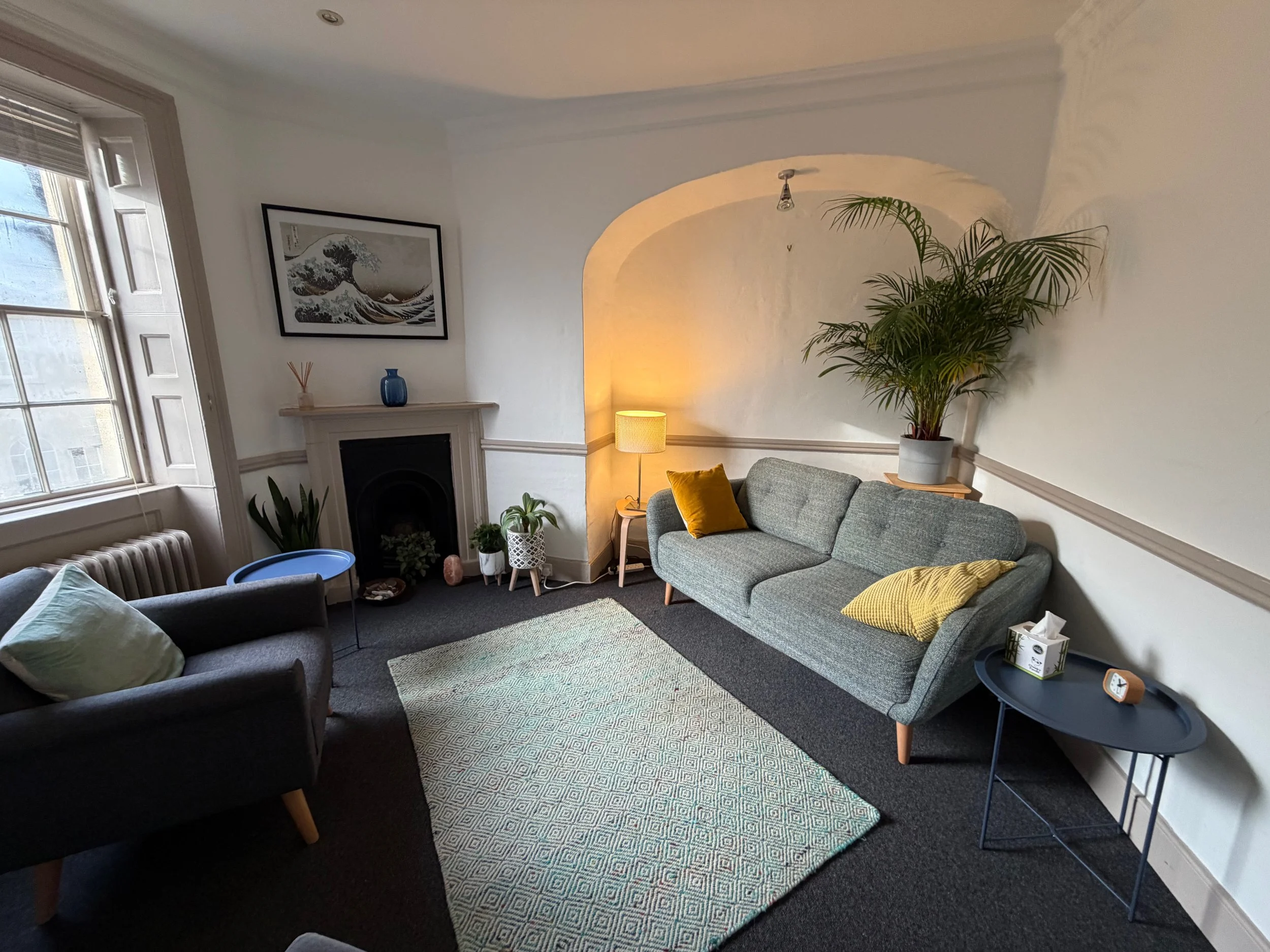
My therapy room is at 35 Brock Street, Bath BA1 2LN.
Brock Street is in the centre of Bath, between the Circus and the Royal Crescent. There is limited street parking but Charlotte Street car park is only a short walk away. I work on the 2nd floor with no lift so if stairs are an issue then please notify me in advance so that we can discuss options.
-
My fee is currently set at £65 per 50 minute session (as of January 2026) and is reviewed in January each year.
Payment is preferred by card in session (all major cards accepted) but alternate arrangements for cash or online payment are available by prior agreement.
I can provide receipts upon request.
-
The initial session (or sessions - we may need more than one) has the overall aim of creating enough safety, clarity and mutual understanding for the work of therapy to begin.
We talk about what’s brought you here now, what you’re hoping for, and any immediate concerns. There’s no pressure to tell your whole story at once. We move at your pace.
An opportunity to get a feel for how I work and whether it feels like a good fit.
A chance for us to develop a shared understanding of what you might need from therapy at this stage.
To set out the frame of our work together covering confidentiality, practicalities etc.
The first few sessions help us understand whether this feels like a good fit. If I think another type of therapy or style of therapist might suit you better I may offer suggestions or a referral. If you feel that we would not be a good fit there is no obligation to continue.
-
You don’t need to arrive with clarity. Many people come to therapy with a sense of unease, overwhelm, or stuckness that is hard to put into words. Part of the work is finding language and understanding together.
-
Sessions last 50 minutes and are held weekly on the same day and time.
Please do not arrive early, in order to preserve your confidentiality and that of other other clients when leaving.
If you arrive late, we still need to end at the agreed time.
Consistent attendance is important for therapeutic progress.
-
Therapy works best when sessions are held at a regular weekly time. I reserve your slot for you alone, and don’t offer it to anyone else. For this reason, sessions that are missed or cancelled are charged for.
Same day cancellations and non-attendance are charged in full. All other missed appointments are charged at 50% of the fee.
This approach is standard in psychotherapy and helps maintain the consistency and stability of the work we do together.
-
I take regular breaks (which I obviously don’t charge for ) throughout the year, and will aways let you know about them with at least a months notice. My pattern is fairly standard: usually two weeks over Christmas, two weeks around Easter, two weeks in the summer and a few shorter pauses at other times.
Breaks can have an impact. For some clients, they offer a chance to practice holding themselves and feeling the work continuing internally. For others, they can stir a need for more holding or bring old anxieties to the surface. Both responses are normal and we can think about them together both before and after the break.
-
The main work of therapy happens when we are in the room together so outside of sessions contact is kept simple. You’re welcome to get in touch between sessions for practical reasons only. I don’t offer therapeutic conversations by email, text or phone outside our agreed session time, so any personal messages will simply be acknowledged and kept for us to think about when we next meet.
-
I ask that clients come to sessions free from the effects of alcohol or drugs. If substance use is something you’d like to explore in therapy, we can do that together - but the session itself needs to be a place where you’re able to be fully present.
-
Our work is confidential, and I am committed to protecting your privacy. That means I will not share what you tell me with others, except in the context of clinical supervision (see below), which is standard requirement for ethical psychotherapy practice. My supervisor is also bound by confidentiality.
There are, however, important legal and ethical limits to confidentiality. These exemptions include situations where I believe there is a serious risk of harm to you or others, or where I am legally required to disclose (e.g. safeguarding, terrorism, money laundering). Wherever possible, I would aim to discuss with you first and seek your consent before taking further steps.
-
To further protect your confidentiality, I keep minimal client records consisting of your contact details and a record of sessions attended.
These are stored securely in compliance with General Data Protection Regulation (GDPR).
-
Sometimes people ask how long therapy takes. There is no fixed timeline, some people come for a short period to focus on something specific, whilst others stay longer as deeper layers unfold.
You are always free to end therapy at any time. However, I strongly recommend that endings are discussed in advance and carefully planned, as a thoughtfully processed ending is an important and meaningful part of the work.
-
If you are in crisis, or worried you may harm yourself or someone else, please seek urgent support. Some helpful resources are listed here:
Emergency services 999 if you or someone else is at immediate risk.
NHS 111 for urgent medical or mental health advice when it isn’t a 999 situation.
Your local NHS Mental Health Crisis Team for acute mental health support.
Samaritans (116123) for free confidential listening at any time.
Your GP who can offer urgent appointments and referrals - ask for an ‘emergency’ or ‘same day’ appointment.
The Bath branch of Mind (bathmind.org.uk) offer both in person and telephone support for people experiencing a mental health crisis.
These services are there to hold you through crisis and help you return to safety. We can then continue our work together within the usual therapeutic frame.